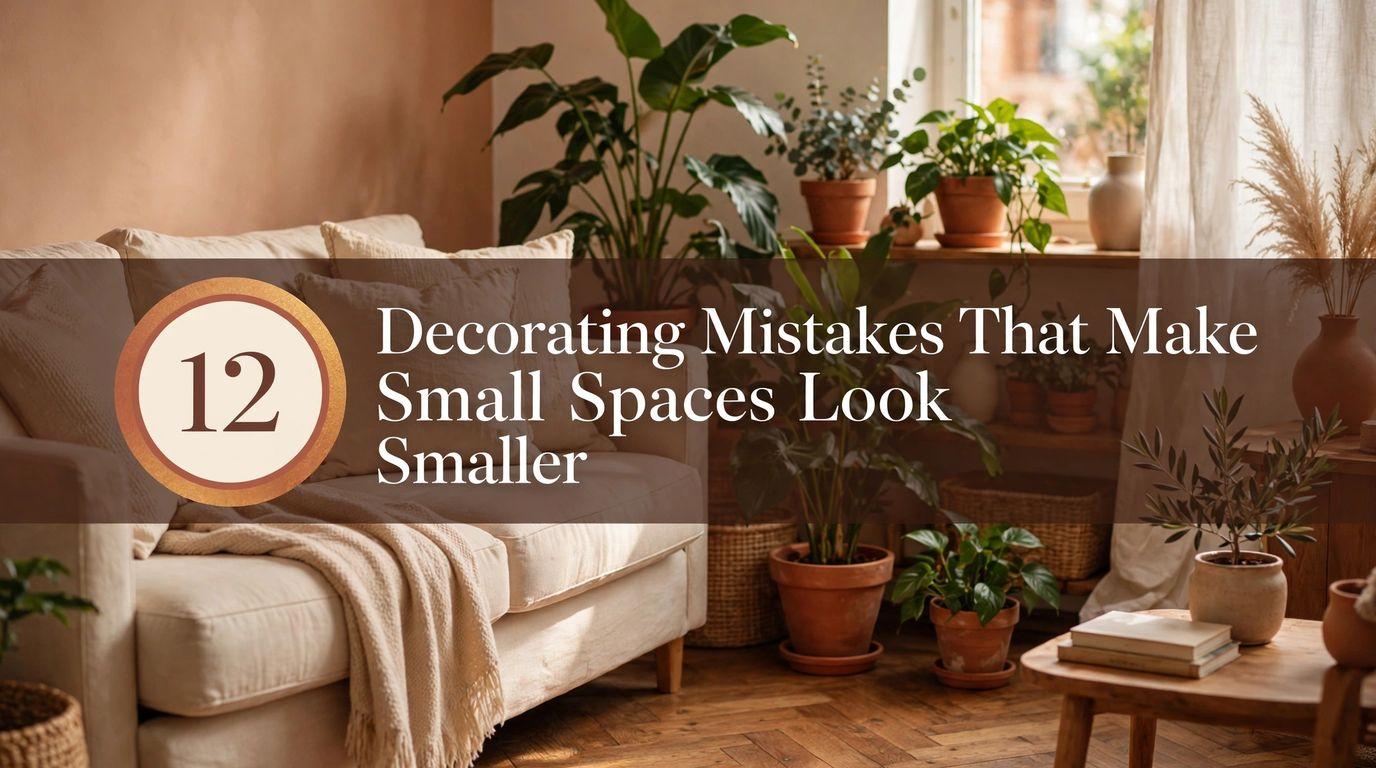
Key Points
- Hang curtains high and wide — low, narrow rods chop your walls and shrink the windows.
- Light beats dark in small rooms — all-dark walls, heavy fabrics, and dark corners close a space in fast.
- Fewer, bigger pieces win — lots of tiny furniture and decor reads as clutter, not cosiness.
- One large rug, mirrors, and lit corners add the most visual square footage for the least effort.
- Every mistake below has a renter-friendly fix — no drilling, no paint, no deposit drama.
Small flats do not have to feel small. Most of the time, it is not the square footage working against you — it is a handful of decorating choices that quietly shrink the room.
The good news is that these are all fixable, and none of the fixes need a drill, a paintbrush, or your landlord’s permission. They are about placement, light, and scale.
Below are the 12 mistakes I see most often in apartments and rentals, each with a concrete fix you can do this weekend. Every one is renter-friendly and deposit-safe.
Work through them one at a time, starting with the curtains and the lighting — those two alone can transform how big your flat feels.
Table of Contents
- 1. Hanging Curtains Too Low and Too Narrow
- 2. Going All-Dark With Nothing Light to Balance It
- 3. Filling the Room With Lots of Tiny Things
- 4. Blocking Windows and Sightlines With Bulky Furniture
- 5. Skipping Mirrors Entirely
- 6. Mixing Too Many Clashing Patterns
- 7. Leaving Corners Dark and Dead
- 8. Smothering Windows in Heavy Fabrics
- 9. Over-Styling Open Shelves Into Clutter Walls
- 10. Chopping the Floor Into Little Rug Islands
- 11. Hanging Tiny Art Too High on Big Empty Walls
- 12. Drowning the Room in Dark Wood and Heavy Finishes
1. Hanging Curtains Too Low and Too Narrow
Credit: @randomdiyguy
Curtains hung at window height
The fix: mount the rod 10–15 cm below the ceiling and extend it 15–20 cm past each side of the frame. The window looks twice as wide and the ceiling looks taller — the two fastest wins in a small room.
A rod that sits just above the window frame and barely covers the glass chops your wall into short sections. The eye stops at the rod instead of travelling up, so the whole room feels squat.
Hang the rod high and wide instead, and let full-length curtains just kiss the floor. Even a narrow rental window looks grand when the curtains frame a much bigger area of wall.
Renting and cannot drill? A wide tension rod wedged inside the reveal, or adhesive brackets on the wall above the frame, does the job with zero holes — and it is one of the simplest no-drill curtain ideas for renters.
🛒 Shop this idea: Amazon Basics Tension Curtain Rod (54–90″)
2. Going All-Dark With Nothing Light to Balance It
Credit: @summerthorntondesign
Dark walls + dark furniture + dark floors
The fix: keep dark to one feature (one wall, or the sofa) and bounce light around it — pale rug, light cushions, and one tall lamp. Dark can be cosy; dark everywhere is a cave.
Moody rooms photograph beautifully, but in a small flat, dark walls plus dark furniture plus a dark floor swallow every bit of light. The corners disappear and the room reads smaller than it is.
You do not have to give up the look. Keep the dark to a single feature wall or one statement piece, then add contrast: a light rug underfoot, cream or caramel cushions, and warm lighting at two different heights. The dark recedes and the light pieces pull the room forward — that contrast is what creates depth.
A tall arc floor lamp is the easiest fix of all: it throws light up to the ceiling and down over the seating area in one go, which visually lifts the whole room.
🛒 Shop this idea: SUNMORY Dimmable Arc Floor Lamp
3. Filling the Room With Lots of Tiny Things
Credit: @bellawanninger
A dozen small bits instead of a few big ones
The fix: swap clusters of tiny decor for fewer, larger pieces. Corral the small everyday stuff into one or two lidded baskets so surfaces stay calm.
It feels logical: small room, small things. But a crowd of little frames, trinkets, and mini plants breaks the room into visual noise, and the eye reads noise as cramped.
Do this instead:
- Pick three larger anchor pieces per room (a big basket, one oversized vase, one large frame) and let them carry the space.
- Gather the small daily bits — remotes, chargers, lip balms — into lidded baskets so they stop colonising every surface.
- Leave some empty surface on purpose. Negative space is what makes a small room feel calm and bigger.
One generous basket beside the sofa holds more, looks tidier, and takes up less visual space than six small pots scattered around it.
🛒 Shop this idea: BEBE BASK Lidded Rattan Storage Baskets, Set of 2
4. Blocking Windows and Sightlines With Bulky Furniture
Credit: @apartmenttherapy
Tall, deep furniture parked in front of light
The fix: choose low-profile, apartment-scale pieces and keep window walls clear. If you can see the window from the door, the room instantly feels bigger.
A high-back sofa shoved against the window, or a deep bookcase blocking the hallway sightline, cuts the room in half visually. Your eye stops at the obstacle instead of travelling through the space.
Keep the path from the door to the window as open as you can. Choose pieces with lower backs and visible legs — seeing floor underneath furniture tricks the brain into reading more floor area. This is also why a good studio apartment layout keeps tall storage on the walls, not in the middle of the sightlines.
When buying new, measure twice and favour “apartment scale”: slimmer arms, shallower seats, and raised legs over chunky recliner-style bulk.
🛒 Shop this idea: Aunekiv Small Mid-Century Accent Chair
5. Skipping Mirrors Entirely
Credit: @sandylandyhomedecor
Not a single mirror in the room
The fix: hang or lean one large mirror opposite (or beside) the window. It doubles the light and fakes an extra window — the cheapest square footage you will ever buy.
Mirrors are the oldest small-space trick in the book, and still the most skipped. A room with no reflective surfaces absorbs light instead of bouncing it, so it feels flat and boxy.
One big mirror beats five small ones: a full-length arched mirror leaned against the wall (no drilling needed) opposite the window throws daylight deep into the room. Beside the window works too — it catches the light at an angle and doubles your view.
Keep the glass clean. A dusty mirror in a dark corner does nothing; a clean one in the light path changes the whole room.
🛒 Shop this idea: WallBeyond Gold Arched Full-Length Mirror
6. Mixing Too Many Clashing Patterns
Credit: @casa_by_jj
Striped rug, floral curtains, geometric cushions, patterned throw — each piece might be lovely, but together they chop a small room into competing zones. The eye never rests, and a restless eye reads a room as smaller.
Pattern mixing is a skill, not a crime. The rule that keeps it safe in small spaces: one pattern at a time, supported by solids. Let the rug carry the pattern, then keep cushions and throws in solid colours pulled from it. Or do the reverse — patterned cushions on a plain sofa and a plain rug.
Stick to one colour family and vary the scale (one large-scale print, one small-scale texture) rather than piling on five loud prints. Calm reads as spacious.
🛒 Shop this idea: Topfinel Throw Pillow Covers, Set of 4
7. Leaving Corners Dark and Dead
Credit: @home.style.by.tiff
Walk into most small flats after dark and you will find one bright ceiling bulb plus four black corners. Those unlit corners are wasted square footage — the room effectively ends where the light stops.
Light every corner and the walls push outward. You do not need wiring: plug-in wall sconces, a small table lamp on a bookcase, or LED strips behind furniture all run off ordinary sockets. Aim for light at three heights — low (table lamp), mid (sconce), and high (floor lamp or uplight).
- Put the brightest accent in the darkest corner, not the one already near the window.
- Warm white (2700K) everywhere — mixed colour temperatures make a small room feel disjointed.
- Plug-in sconces with adhesive or minimal fixings are fully renter-friendly and move with you.
This pairs perfectly with proper small living room lighting ideas — layers, not one lonely bulb.
🛒 Shop this idea: TRLIFE Plug-In Wall Sconces, Set of 2
8. Smothering Windows in Heavy Fabrics
Credit: @homebynidhi
Thick blackout curtains in a dark colour, kept half-drawn all day, are a daylight tax on a small flat. Natural light is the single biggest “space maker” you have, and heavy drapes block it at the source.
Swap to light-filtering sheers in white or ivory. They soften the light, keep your privacy, and let the room glow during the day. Layer a separate blackout blind behind them only if you need real darkness for sleep — roll it up fully each morning.
Keep the sheers wide and full even when open: bunched fabric stacked neatly at the sides frames the window instead of covering it. The glass stays visible, the light pours in, and the room breathes.
🛒 Shop this idea: Chyhomenyc Light-Filtering Sheer Curtains
9. Over-Styling Open Shelves Into Clutter Walls
Credit: @calumharper
Open shelves are great small-space storage — until every centimetre is crammed with books, jars, and ornaments. A packed shelf wall becomes one big block of visual noise, and it makes the whole room feel crowded.
Give each shelf breathing room. The designer rule of thirds works well:
| Third | What goes there |
|---|---|
| Books / practical | Upright books, grouped tightly |
| Decorative | One vase or frame, nothing else |
| Empty / basket | A woven basket hiding the messy bits |
Leave one shelf in three mostly empty. That empty space is doing the heavy lifting — it is what makes the styled shelves look intentional instead of hoarded.
🛒 Shop this idea: Mkono Woven Rope Storage Basket
10. Chopping the Floor Into Little Rug Islands
Credit: @rugs_usa
Three small rugs — one by the sofa, one by the door, one floating in the middle — break the floor into patches. Every edge is a visual stop sign, and the room reads as a collection of fragments instead of one flowing space.
One large rug does the opposite: it pulls the furniture together and makes the floor read as a single, generous surface. In a small living room, go for the biggest rug the space can take — ideally with the front legs of the sofa and chairs sitting on it.
If you genuinely need two zones (say, living and dining in one room), use one rug per zone with a clear gap of bare floor between them. Two deliberate zones look designed; five random mats look accidental.
🛒 Shop this idea: SIILOOM Vintage-Style 5×7 Area Rug
11. Hanging Tiny Art Too High on Big Empty Walls
Credit: @casaardolino
A single postcard-sized frame floating near the ceiling, with a vast empty wall below it, makes the wall look bigger and emptier — which makes the room feel smaller and sadder. Scale matters more than quantity.
Art should sit at eye level: the centre of the piece (or the gallery grouping) around 145–150 cm from the floor. And go bigger than you think — one large piece, or a generous gallery wall that fills two-thirds of the sofa’s width, anchors the room properly.
Renters, take note: picture-hanging strips hold real weight now, so a big gallery wall needs zero nails. Lay the arrangement on the floor first, photograph it, then transfer it to the wall.
🛒 Shop this idea: Americanflat 7-Piece Gallery Wall Frame Set
12. Drowning the Room in Dark Wood and Heavy Finishes
Credit: @anainteriors.nyc
Dark wood bookcase, dark wood coffee table, dark leather sofa, heavy bronze lamp — each piece is fine alone, but together they form a visual weight that presses the room down. Heavy finishes absorb light the same way dark walls do.
You do not need to replace everything. Break up the darkness with contrast:
- Add one or two light upholstered pieces — a cream ottoman or a pale bench instantly lifts a dark seating area.
- Drape a light throw over the darkest chair and swap in pale cushions.
- Choose light-finish accessories (rattan, pale wood, linen) for the pieces you add next.
Think of it as a ratio: for every two dark, heavy pieces, add one light, soft one. The room keeps its character but stops feeling like a cave.
🛒 Shop this idea: SONGMICS 30″ Folding Storage Ottoman Bench
Amazon prices change often — check Amazon for today’s price.
Conclusion
None of these mistakes are about taste — they are about visual tricks that work against small rooms. Curtains hung low, dark corners, tiny scattered pieces, and chopped-up floors all tell the eye the room is smaller than it is.
The fixes share one theme: let light travel, keep sightlines open, and choose fewer, bigger, lighter things. Start with the two highest-impact changes — curtains hung high and wide, and light in every corner — and you will feel the difference the same evening.
Everything here is renter-friendly, so there is no reason to live with a flat that feels smaller than it is. Pick one mistake, fix it this weekend, and enjoy the extra “space”.
FAQs
What is the single biggest mistake that makes a small room look smaller?
Hanging curtains too low and too narrow. It shortens the walls and shrinks the windows in one move. Mounting the rod near the ceiling and extending it past the frame is the fastest, cheapest fix with the biggest visual payoff.
Do dark colours always make small spaces look smaller?
Not always — one dark accent wall can add depth. The problem is dark on every surface with nothing light to balance it. Keep dark to a single feature, add light textiles and layered lighting, and a small room can carry moody colours beautifully.
What size rug makes a small living room look bigger?
The largest the room can take — ideally 5×7 feet or bigger, with the front legs of the sofa and chairs on it. One large rug unifies the floor; several small rugs chop it into fragments that make the room feel smaller.
How can I make my rental look bigger without drilling or painting?
Lean a large mirror opposite the window, hang curtains high on a tension rod, add plug-in lighting to dark corners, and swap heavy dark textiles for light ones. All of it is removable and deposit-safe.
Should small rooms have small furniture?
Not necessarily — and that is the trap. Lots of tiny pieces read as clutter. Fewer, properly-scaled pieces with visible legs (so you see floor beneath them) make a small room feel calmer and more spacious than a crowd of mini furniture.