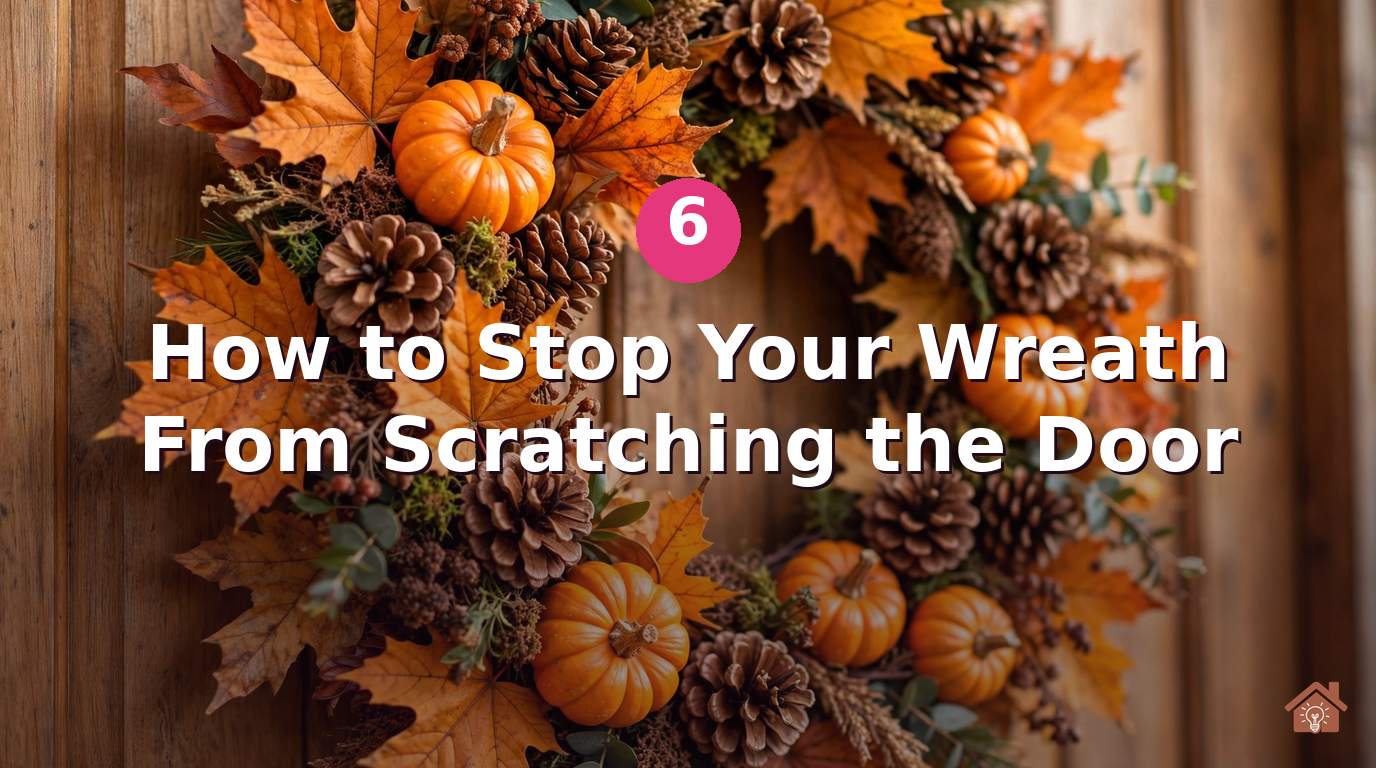
You take your fall wreath down in late November, and there they are — thin scratches and dull rub marks right where it hung all season. Your stomach drops a little.
Here is the good news. Those marks are almost always preventable, and the fixes cost very little. Most of them take under ten minutes.
Scratches happen for three simple reasons: bare metal touching paint, the wreath swinging in the wind, and tiny bits of grit getting trapped between the wreath and the door.
This guide walks you through six fixes, starting with the cheapest. Do even two of them and your door will stay mark-free all season long.
Main cause: an exposed metal frame rubbing the paint, made worse every time the wind moves the wreath.
✓ Fastest fix: stick felt pads or felt strips on the back of the wreath frame.
✓ Best hanger: a padded over-door hook. Skip thin bare-wire hangers.
✓ A soft backing plus the right hang height stops nearly all damage.
Table of Contents
- Why Your Wreath Scratches the Door
- Fix 1. Stick Felt Pads on the Wreath’s Back
- Fix 2. Swap the Wire Hanger for a Padded Hook
- Fix 3. Give the Wreath a Soft Fabric Backing
- Fix 4. Shield the Door Itself With a Clear Guard
- Fix 5. Hang It at the Right Height and Keep It Still
- Fix 6. Store It Right So Wires Never Poke Out
- Conclusion
- FAQs
Why Your Wreath Scratches the Door
Credit: @theluxeoccasion
Almost every wreath has a metal frame hiding under the greenery. Wire ends, twist ties, and stiff stems poke out the back where you cannot see them. Pressed against your door for weeks, that bare metal is the number-one scratch culprit.
The second culprit is movement. A wreath that swings in the wind rubs the same spot hundreds of times a day. Even soft foliage becomes sandpaper with enough repetition, and one breezy week can dull a whole patch of paint.
The third culprit is grit. Dust and tiny grains of sand get trapped between the wreath and the door. Every small shift grinds them into the finish. Painted wood doors show it as dull rub marks; glass doors can pick up fine hairline scratches too.
Knowing this changes how you hang the wreath. You are not just decorating — you are keeping hard metal, movement, and grit away from the finish. The six fixes below each tackle at least one of the three.
Fix 1. Stick Felt Pads on the Wreath’s Back
Credit: @heysunshinefloral
This is the cheapest and fastest fix there is. Self-adhesive felt pads — the kind sold for chair legs — cost a few dollars and take five minutes to apply. Stick four to six pads on the back of the wreath frame, right where it touches the door.
Place pads at the top, bottom, and sides so no bare metal can reach the paint. Press each one firmly for ten seconds so the adhesive bonds to the frame, not just the foliage. If your wreath is heavy, use the thicker furniture-grade pads.
Felt strips work the same way and cover longer contact areas. Cut them to length, peel, and stick along the back of the frame. They also dampen swinging, which tackles the movement problem at the same time.
Check the pads once a season. If one peels off, replace it before the metal touches the door again. This single fix prevents most scratches on its own.
Fix 2. Swap the Wire Hanger for a Padded Hook
Credit: @lonihaskellinteriors
Thin wire hangers are a hidden scratch machine. They concentrate the whole wreath’s weight on a narrow metal edge, and they slide side to side in the wind, sawing at the paint. If your hanger is bare wire, replace it.
A padded over-door bracket is the safest choice. It hooks over the top of the door, spreads the weight across a wide area, and the foam or rubber coating keeps metal off the finish. Look for one with padding on both the front and the door-facing side.
Match the bracket to your door thickness so it sits snug without wobbling. A bracket that is too loose will rock and rub the top edge every time the door moves. If you want more no-damage hanging ideas, see how to hang a wreath without nails or damage.
Fix 3. Give the Wreath a Soft Fabric Backing
Credit: @maplehomeedit
Felt pads protect the contact points, but a full soft backing protects the whole wreath. Cut a circle of felt, craft foam, or fabric to match your wreath frame and fasten it to the back with zip ties or a few dots of hot glue.
The backing does two jobs at once. It covers every wire end and twist tie, and it gives the wreath a smooth, even surface that glides instead of grinding. Choose a colour close to your frame so it disappears from the front.
This trick is a must for glass doors, where even light rubbing shows up as cloudy marks. It also hides the wreath’s mechanics, so the back looks tidy if anyone glimpses it from the side. Browse fall wreath ideas for your front door to pick a style worth protecting.
Fix 4. Shield the Door Itself With a Clear Guard
Credit: @apeercompositedoors
Sometimes the smartest move is protecting the door instead of the wreath. A clear adhesive film or a door-protector pad stuck on the door behind the wreath takes all the rubbing so your paint does not have to.
Cut the film slightly larger than the wreath and smooth it on with a credit card to push out bubbles. From the street it is invisible, and most films peel off cleanly at the end of the season. This is a favourite for renters because the door itself never gets touched by hardware.
Pair the guard with felt pads on the wreath for belt-and-braces protection. The pads cushion the wreath, the film shields the door, and together they handle wind, grit, and metal all at once.
Fix 5. Hang It at the Right Height and Keep It Still
Credit: @sydenhamhouse
A wreath hung too low bangs against the door every time it swings. Hang it at eye level, centred on the door, with clear space above and below so it never knocks the frame or the kick plate.
Then stop the swing. A ribbon looped over the door holds the wreath flat and steady, and a second anchor point — a small adhesive hook at the bottom of the wreath — keeps it from twisting in gusts. A wreath that cannot move cannot rub.
After the first windy day, check the wreath’s position. If it has shifted, tighten the hanger or add a felt pad where it now touches. If you made the wreath yourself, revisit how to make a fall wreath and build the hanger into the design from the start.
Fix 6. Store It Right So Wires Never Poke Out
Credit: @gooddealsbayou
Many scratches are actually caused by last year’s storage. A wreath crushed in a box comes out with bent wire ends poking in every direction — and those sharp points go straight onto your door paint.
At the end of the season, inspect the back of the wreath before you put it away. Straighten bent wires, clip sharp ends, and cover any exposed metal with small squares of duct tape or felt. It takes five minutes and saves next year’s paint.
Store the wreath hanging or in a wreath box, never wedged under heavy bins. A wreath that keeps its shape hangs flat, touches the door evenly, and gives you nothing sharp to worry about when fall comes back around.
- Felt pads stuck on the wreath’s back at every contact point
- Padded over-door hook, matched to your door thickness
- Soft backing covering wire ends and twist ties
- Wreath centred at eye level with room to clear the frame
- Second anchor point so wind cannot swing it
Conclusion
Stopping wreath scratches comes down to one idea: never let hard metal rub your door. Felt pads, a padded hanger, and a soft backing handle the metal. The right height and a steady hang handle the movement.
Pick any two fixes from this guide and your door will look just as good in December as it did in September. For more seasonal inspiration, explore these fall wreath ideas for your front door — and hang each one with confidence.
FAQs
Will felt pads damage my door paint?
No. The pads stick to the wreath, not the door, so your paint never touches adhesive. Use felt rather than rubber pads, since rubber can leave marks in heat. Replace pads each season so worn ones do not expose the frame.
Can I hang a wreath on a glass door without scratching it?
Yes. Use a suction-cup or adhesive hook rated for the wreath’s weight, add a full felt or fabric backing to the wreath, and keep it from swinging. Glass shows fine scratches easily, so the backing matters even more here.
My door is already scratched. Can I fix it?
Light rub marks often buff out with a mild polishing compound. Deeper scratches need a touch-up: lightly sand the spot, apply matching exterior paint with a small brush, and let it cure fully before hanging anything again.
Are over-door hangers bad for the door finish?
Bare metal brackets can dent or rub the top edge of the door. Choose a bracket with foam or rubber padding on every surface that touches the door, and make sure it fits your door thickness so it does not rock.
How do I stop my wreath spinning in the wind?
Give it two anchor points instead of one. Hang the wreath from the top as usual, then add a small adhesive hook behind the bottom of the wreath to hold it flat. A ribbon looped over the door also keeps it steadier than a single wire.