
Small Bedroom Makeover on a Budget: 15 Smart Changes to Make First
Affiliate disclosure: As an Amazon Associate I earn from qualifying purchases.
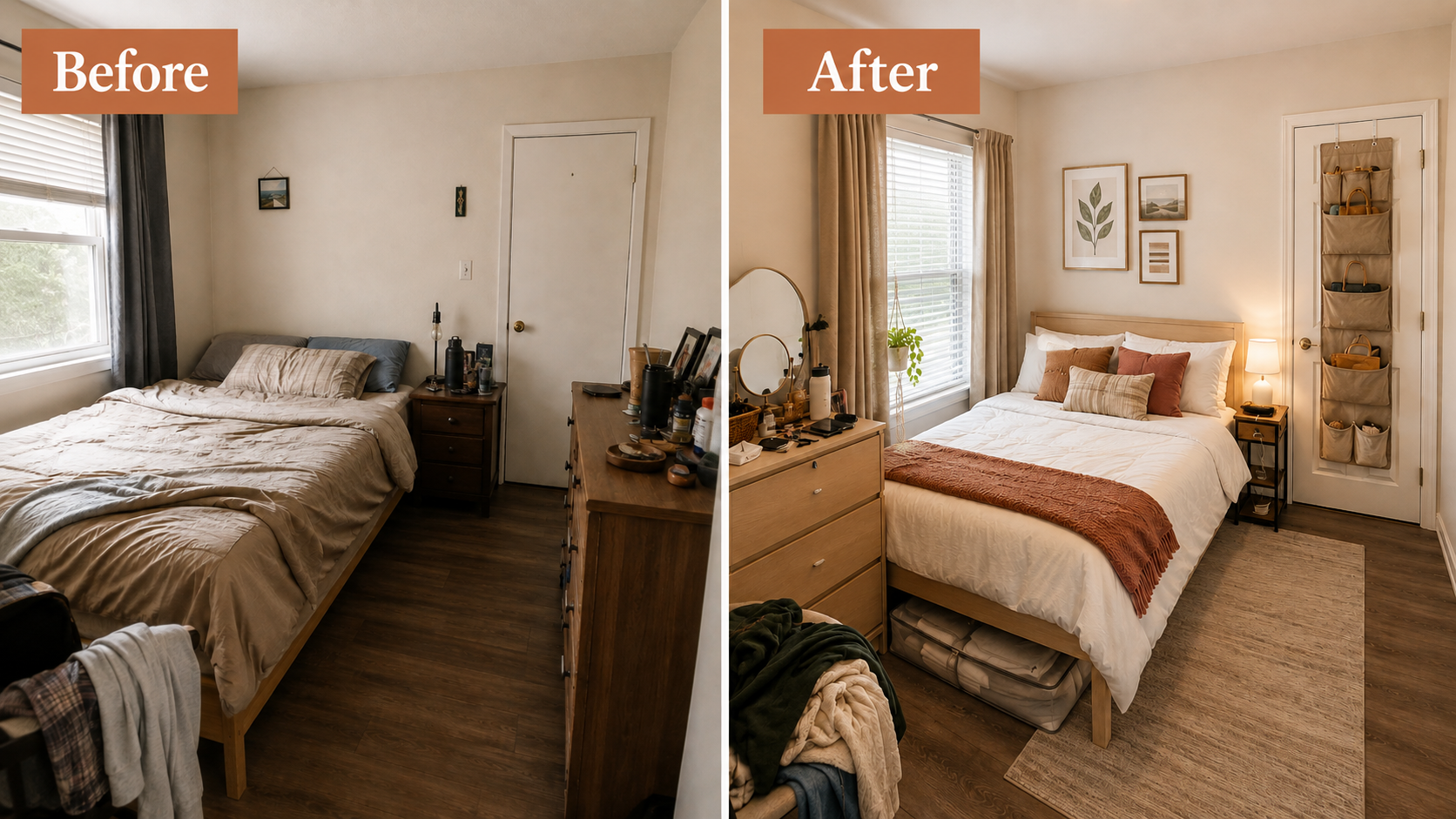
A small bedroom makeover can get expensive surprisingly fast when you start shopping before deciding what the room actually needs. A new rug leads to new bedding, then a lamp, then wall decor, and suddenly the room looks different but the storage problem, awkward layout, or bad lighting is still there.
A small bedroom makeover on a budget works better when you spend in order of impact.
Start with the free changes. Fix the layout. Remove visual clutter. Improve the bed area. Then use your remaining budget on the few things that affect the largest part of the room, such as lighting, curtains, wall treatment, or storage.
You do not need to buy something for every section below. Treat this as a makeover menu. If the room already has good lighting, skip that expense. If your bedding works, keep it. The goal is to finish with a bedroom that looks more intentional and functions better without spending money simply because there is room left in the budget.
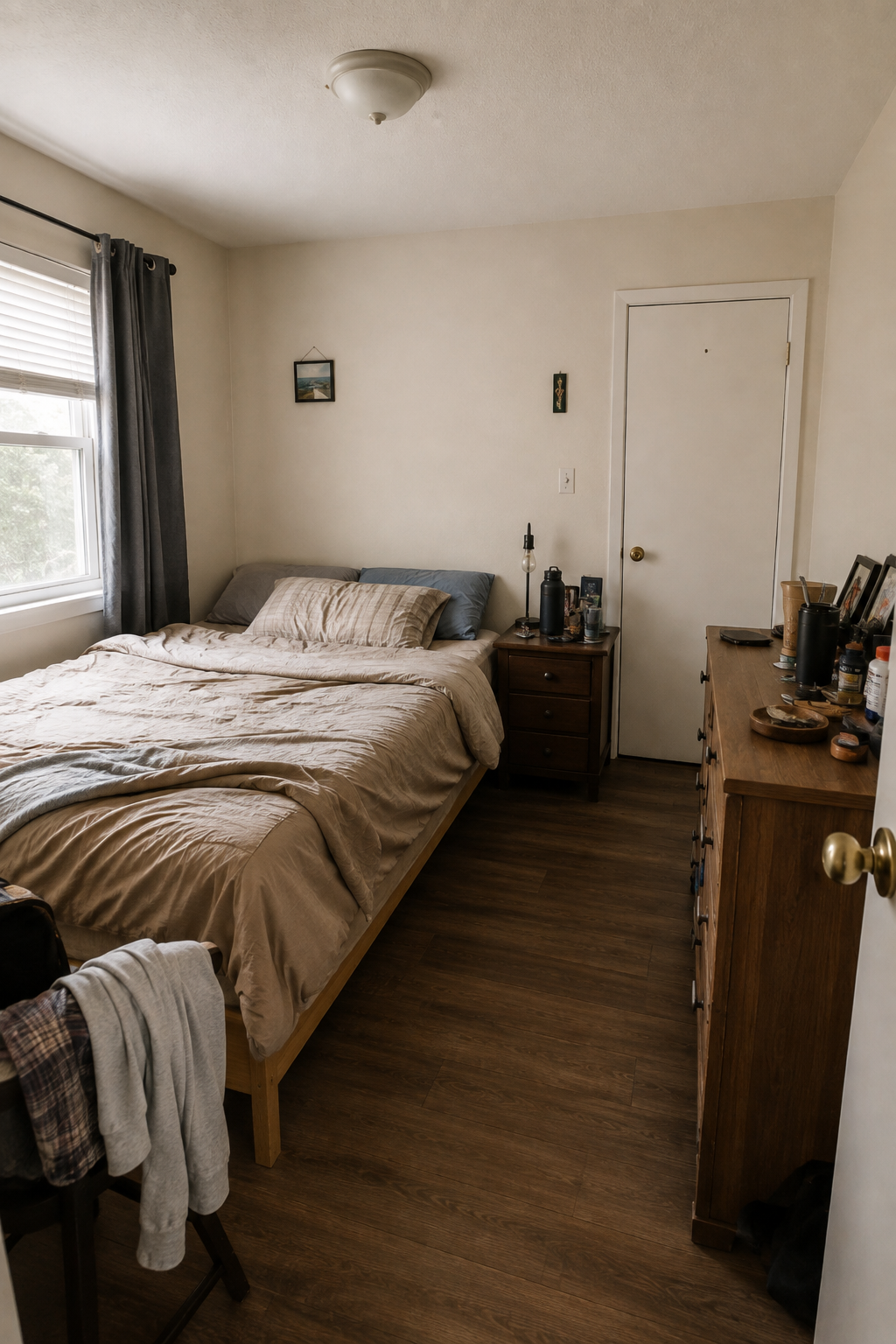
Start With the Budget, Not the Shopping Cart
1. Clear the Room Before Spending a Dollar
Budget target: $0
Take everything off the dresser, nightstand, chair, windowsill, and floor that does not need to be there every day.
This matters because clutter can make a room look as though it needs more storage, more furniture, and more decor when the real problem is simply too much stuff in sight.
Make four quick groups:
- keep in the bedroom
- relocate elsewhere
- donate or sell
- throw away
Do not buy baskets yet. First find out what actually needs storing.
If clothes are the main source of clutter, that problem belongs in a deeper small bedroom storage and organization plan rather than being covered with decorative bins.
Save move: selling one unused item can even create part of the makeover budget.
2. Test a Better Bed Position Before Buying Furniture
Budget target: $0
The bed controls most of the room, so changing its position can have more impact than buying a new side table or rug.
Measure the walls and test whether another placement creates:
- a clearer route to the door
- better closet access
- enough room for a desk
- more useful space on one side of the bed
- better natural light
A symmetrical layout is not automatically the best layout in a small room.
If moving the bed creates one wider usable zone instead of two narrow, useless strips of floor, that is often the better trade.
For rooms where the bed itself is the main challenge, a future small bedroom layout with a queen bed article should handle the full layout problem.
Save move: rearrange before replacing.
3. Pick a Three-Part Color Plan Before You Shop
Budget target: $0
A clear color plan helps prevent impulse purchases that look good alone but fight with everything else in the room.
Choose:
- one main neutral
- one accent color
- one supporting material or tone
For example:
- warm white
- muted terracotta
- natural wood
or:
- soft beige
- sage green
- black metal
Once the palette is set, shop your own home first. A lamp, frame, throw, basket, or cushion from another room may suddenly work here.
Budget rule: if a new item does not fit the palette or solve a practical problem, do not buy it yet.
4. Put the Biggest Share of the Budget Into the Bed Area
Suggested budget target: about 25 to 35% of your makeover budget

The bed is usually the largest visual surface in a small bedroom, so this is where a modest spend can change the whole room.
Do not assume you need a completely new bedding set.
Start with what you already own and ask what is actually letting the bed down.
It may only need:
- two new pillow covers
- a better-fitting duvet cover
- a throw at the foot
- a simpler color combination
If the comforter is still good, keep it.
Decorative pillows should stay limited enough that they do not become floor clutter every night.
Save move: change the layers people notice first, not every layer of the bed.
5. Improve the Lighting Before Buying More Decor
Suggested budget target: about 10 to 20%

Lighting can change how almost every other purchase looks.
A room with better bedding and nicer wall decor can still feel flat under one harsh ceiling light.
Consider one useful secondary light source:
- bedside lamp
- compact desk lamp
- plug-in wall light
- small floor lamp if space allows
For a renter, plug-in lighting is usually easier to reverse than hardwired changes.
Try to solve both mood and function. If you read in bed, the light should actually help you read.
Do not spend here if you already have good layered lighting. Move that money to the room’s bigger weakness.
IMAGE PLACEHOLDER: Bedside lighting detail during the makeover.
6. Spend on One Wall Instead of Decorating All Four
Suggested budget target: 10 to 15%

A small room usually looks more intentional when one wall carries most of the visual interest and the others stay quieter.
The wall behind the bed is often the easiest place to focus your money.
Possible low-cost directions include:
- a compact gallery wall
- posters in matching frames
- removable wall decor
- one oversized art piece
- a painted accent area if permitted
- peel-and-stick treatment where suitable for the wall and lease
The important part is concentration.
Five unrelated decorations scattered around four walls can cost more and still look less finished than one deliberate wall.
For more focused ideas later, link naturally to small bedroom wall decor ideas.
7. Reuse or Thrift a Mirror Before Buying One New
Suggested budget target: $0 to modest
A mirror can help with dressing, add visual height, and move light around the room, but it does not need to become a major purchase.
Check whether another mirror in your home can be relocated first.
Secondhand shops and local resale listings can also be useful places to look because the frame matters less than the size and condition.
If the frame does not suit the room, a simple finish change may be cheaper than buying another mirror.
Choose the location based on function:
- near a dressing area
- where it can catch daylight
- on a wall that feels visually empty
Skip this expense if the room already has a useful mirror.
8. Decide What Is Actually Worth Buying
✓ Bedding you touch every day
✓ Storage that removes real clutter
✓ Curtains if the current ones hurt the room
○ Decorative trays
○ Trend-only accessories
○ Duplicate storage containers
○ Decor for empty space that already looks fine
Use this checkpoint before continuing.
If the room already feels much better after decluttering, rearranging, improving the bed, and changing the lighting, you may not need to finish all 15 ideas.
That is a successful budget makeover, not an incomplete one.
9. Fix the Window Only If It Is Visually Hurting the Room
Suggested budget target: 0 to 15%
Curtains occupy a large area, so they can have a strong visual effect.
But replacing them automatically is a waste if the current ones already work.
Consider changing them when they are:
- noticeably too short
- extremely heavy for the room
- badly faded
- fighting with the new palette
- blocking more daylight than you want
Reuse the existing curtain rod when possible.
A neutral panel can also stay useful after future decor changes, making it a better budget choice than a very specific trend print.
Before shopping, measure both the window and the existing hardware.
Save move: improve the curtain styling before replacing the curtains themselves.
10. Skip the Rug Unless It Solves a Real Visual Problem
Suggested budget target: $0 unless needed
A rug is one of the easiest items to add because it makes a room look “decorated,” but it can also consume a large part of a limited budget.
Ask whether the floor actually needs one.
If you already have comfortable carpet or flooring that works with the room, use that money elsewhere.
If the floor feels cold, visually disconnected, or too bare, then a rug may earn its cost.
Measure before shopping. A rug that is too small can make the bed area look more fragmented rather than more finished.
A detailed small bedroom rug ideas article can later handle placement and sizing separately.
11. Use Under-Bed Space Before Paying for Another Dresser
Suggested budget target: low

Storage purchases should solve specific categories of clutter.
The area beneath the bed is usually better for:
- extra bedding
- seasonal clothes
- shoes
- less frequently used items
It is usually worse for items you need several times each day.
Measure the height beneath the bed before buying containers.
If you already own shallow bins or zippered storage bags that fit, use those first.
Budget rule: do not buy a large new piece of furniture until you know the existing hidden spaces are actually being used well.
12. Replace an Oversized Nightstand Only If It Frees Useful Space
Suggested budget target: low to moderate

Do not replace a nightstand just because a smaller one looks better in photographs.
Replace it when the current piece blocks movement or uses far more space than your routine requires.
List what you genuinely need beside the bed:
- phone
- water
- book
- lamp
- medication or glasses
- small drawer storage
Then choose the smallest solution that handles those needs comfortably.
A stool may be enough for one person. Someone who needs closed storage may need a narrow drawer unit instead.
This is a good future opportunity for nightstand alternatives for small bedrooms.
Save move: repurpose a side table from another room before shopping.
13. Add Vertical Storage Only for Items That Need a Home
Suggested budget target: low to moderate

Vertical storage is useful because it takes advantage of wall height, but adding shelves everywhere can make the room look busier.
Start with the item causing the problem.
- Books?
- Shoes?
- Handbags?
- Extra clothes?
- Decor?
Then choose one vertical solution for that category.
Possible renter-conscious options include freestanding tall storage, over-door organizers, and other removable solutions that suit the room and lease.
Avoid buying a shelving unit and then filling it with decor simply because the shelves look empty.
Storage should remove clutter, not create a new display problem.
14. Style One Surface With Things You Already Own
Budget target: $0
Choose one small area to make intentional.
That might be:
- the dresser
- nightstand
- windowsill
- narrow shelf
Try three elements maximum at first.
For example:
- one useful object, such as a lamp
- one personal or decorative item
- one natural element
Then leave some empty surface visible.
The empty space makes the objects look chosen rather than stored.
Walk around your home before buying finishing decor. Frames, books, small pottery, trays, and vases often work differently when moved into a new room.
Save move: shop the house before you shop a store.
15. Wait One Week Before Buying the Final Accessories
Budget target: $0
Once the room is cleaner, better arranged, and visually consistent, stop.
Live with it for several days.
You may discover that the empty wall you wanted to fill actually gives the room breathing space. You may notice that the real problem is one dark corner rather than a lack of decor.
Take photos from several angles too. Photos often reveal clutter and visual imbalance more clearly than standing inside the room.
After a week, make a very short final shopping list.
If the list says “decor,” it is still too vague.
Write the actual missing need instead:
“small lamp for dark corner”
or
“closed basket for extra blankets”
That prevents the final $20 or $30 from disappearing into things the bedroom never needed.
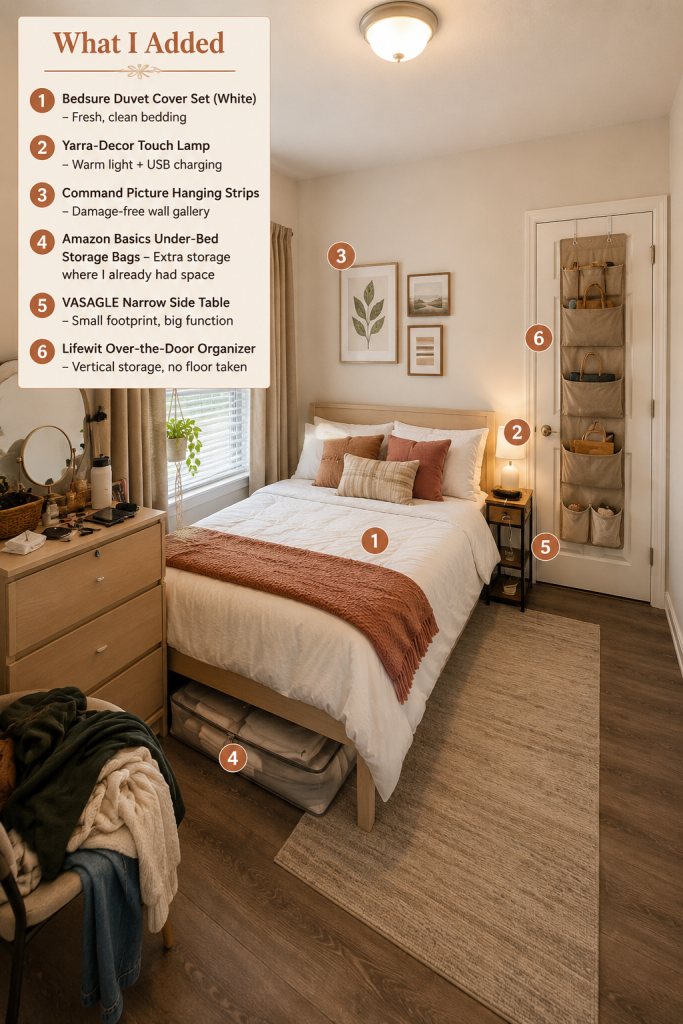
A Sample $200 Small Bedroom Makeover Plan
A $200 budget can work as a planning cap when you keep your major furniture and avoid renovation work.
This is not a claim about current retail prices. It is a suggested way to divide a fixed budget so one category does not accidentally consume all of it.
The $40 flexible buffer matters more than forcing yourself to spend exactly $30 in every category.
If the existing bedding looks good, move that money to storage.
If the curtains are already fine, keep the money.
A budget is a maximum, not a target you are required to hit.
Renter-Friendly Swaps That Keep the Makeover Reversible
| Instead of | Consider | Why |
|---|---|---|
| Custom built-ins | Freestanding storage | It can move with you. |
| Hardwired bedside light | Plug-in light | Less permanent work. |
| Permanent wall treatment | Removable option where appropriate | More practical at move-out. |
| Large custom furniture | Compact movable furniture | More flexible in the next home. |
Always check your lease and follow the instructions for any removable product on the exact surface where you plan to use it.
For a more complete rental-specific plan, naturally link this section later to small bedroom ideas for renters.
Small Bedroom Makeover FAQ
How much should I spend on a small bedroom makeover?
There is no single correct amount. Start by deciding what you can comfortably spend without treating the full amount as money that must be used.
A limited budget is easier to control when you separate it into priorities such as bedding, lighting, storage, and one visual upgrade.
If the room improves after the free changes, stop early and keep the remaining money.
What should I buy first for a bedroom makeover?
Do not buy anything first.
Declutter and test the layout before shopping.
After that, spend on the most noticeable unresolved problem. In many rooms that will be the bed, lighting, window treatment, or storage.
Small accessories should usually come later.
How can I makeover my bedroom without buying new furniture?
Keep the furniture and change how the room works around it.
Try:
- rearranging the layout
- removing unnecessary pieces
- restyling the bed
- changing lighting
- relocating decor from another room
- improving one wall
- using hidden storage more efficiently
Changing the relationship between existing pieces can make the room feel surprisingly different.
Can renters do a small bedroom makeover?
Yes, but the exact changes depend on the lease.
Favor movable and reversible improvements when permanent changes are not allowed. Freestanding storage, plug-in lighting, textiles, art, bedding, and carefully selected removable products can all change the room without turning the project into a renovation.
What makes the biggest difference in a small bedroom?
Usually the changes that affect the largest visual or functional areas.
That often means:
- better layout
- less clutter
- a more intentional bed
- improved lighting
- controlled storage
- one clear color direction
Several tiny accessories rarely create the same impact.
Before You Call the Makeover Finished
Make the Budget Work Harder Than the Decor
A good small bedroom makeover does not come from buying the most things.
It comes from noticing what affects the room every day, fixing those problems first, and refusing to spend on details that do not improve the space.
Start with the free changes. Put your money into the bed, lighting, storage, or another high-impact weakness. Reuse what already works. Leave some blank space.
The best small bedroom makeover on a budget is not the one that looks the most expensive. It is the one where almost every dollar has a clear reason for being there.
Fix the problems you notice every day before buying decor for the spaces that already work.
Save this plan for your next bedroom refresh, then start with the first change that costs nothing.
One Comment