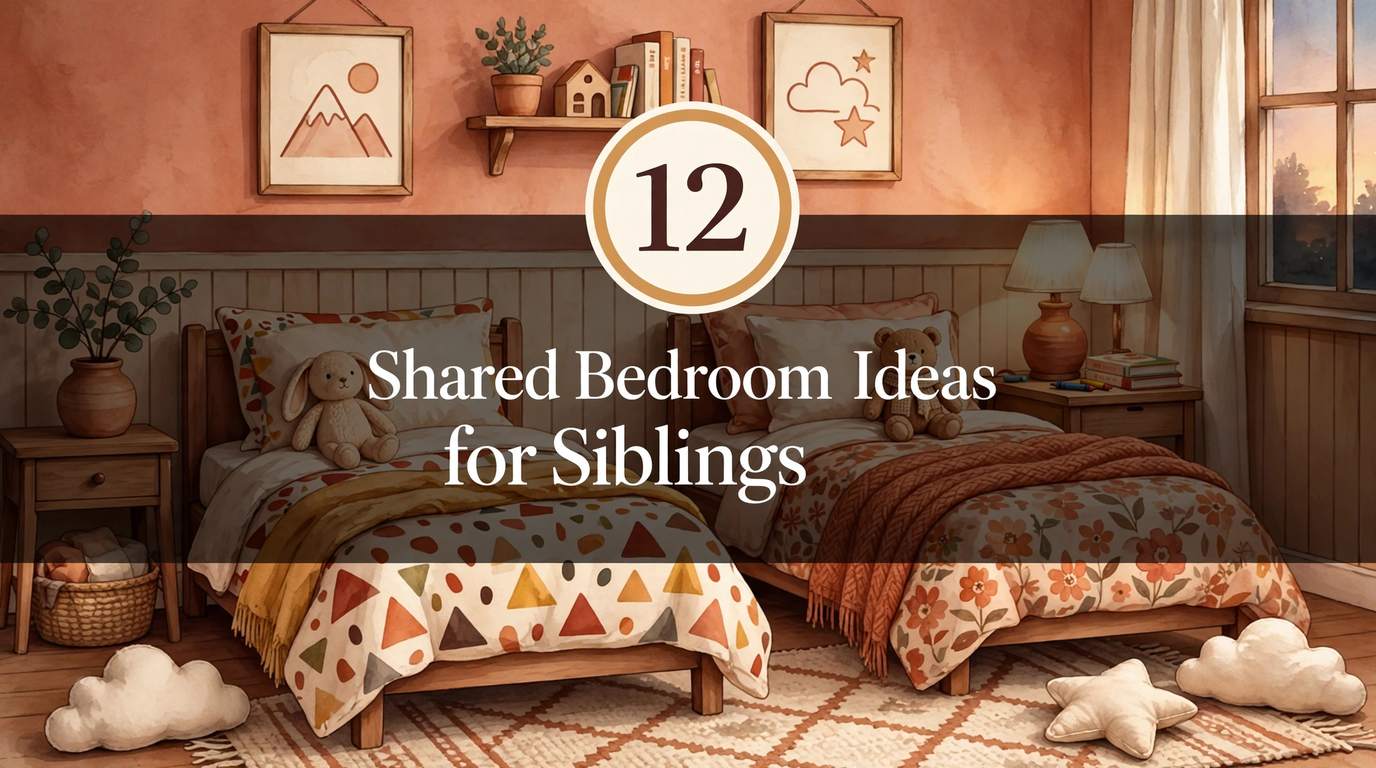
Sharing one bedroom between two kids is one of the trickiest puzzles of flat living. Space is tight, tempers can flare, and every single inch has to work twice as hard.
The good news? You do not need a bigger flat, and you do not need a drill. With renter-friendly tricks like bunk beds, no-drill dividers and peel-and-stick finishes, siblings can share happily — and you still get your deposit back.
These 12 shared bedroom ideas for siblings are built for apartments: small footprints, landlord-safe fixes, and clever storage that gives each child a corner of their own.
Pick the ideas that fit your room, mix and match a few, and watch the bickering fade. Let’s dive in.
✓ Key points
- Bunk and loft beds free up the floor — the single biggest win in a small shared room.
- No-drill curtain dividers give each child privacy without touching the walls.
- Peel-and-stick wallpaper and decals add personality and come off cleanly at move-out.
- Under-bed drawers and cube storage double what the room can hold.
- Personal zones — bedding, art, a shelf each — cut most sibling arguments.
Table of contents
- 1. Go classic with a space-saving bunk bed
- 2. Match twin beds, then personalise with name art
- 3. Hang a no-drill curtain divider down the middle
- 4. Try a loft bed with a desk tucked underneath
- 5. Split the room into two colour zones
- 6. Style one nightstand to serve two kids
- 7. Roll under-bed drawers in for double storage
- 8. Add a peel-and-stick wallpaper accent wall
- 9. Colour-code bedding so each child owns their look
- 10. Fit two compact desks into one homework zone
- 11. Use a low bookcase as a divider with storage
- 12. Pick a bunk setup that works for mixed ages
- Conclusion
- FAQs
1. Go classic with a space-saving bunk bed
Credit: @apartmom
Bunk beds use the footprint of one bed for two sleepers — nothing else saves that much floor in a small flat.
The humble bunk bed is still the king of shared kids’ rooms, and this small bedroom idea for renters proves it: a light-wood bunk with yellow bedding fits two kids into a room of barely 100 square feet in a Manhattan flat, with space left for a tricycle and books.
Look for a freestanding bunk that needs no wall fixing — many split into two separate twin beds later, which is perfect when the kids eventually get their own rooms. Keep the top bunk for the older child and add a clip-on reading light so the lower bunk does not feel like a cave.
Why it works in rentals: no drilling, no wall damage, and it dismantles in an afternoon when you move.
🛒 Shop this idea: KepStars Battery Operated Fairy String Lights, 4-Pack
2. Match twin beds, then personalise with name art
Credit: @nitraab
Matching beds say ‘you are equals’; the personalised art above each one says ‘but you are you’.
Two matching light-wood twin beds in navy bedding, with big script lettering spelling each brother’s name above his bed — this calm, simple setup shows how matching furniture plus personal touches keeps things fair and fun.
- Keep the big pieces identical: same bed, same bedding style, same lamp. Fewer things to fight over.
- Personalise above the pillow: removable name decals, framed prints or a small photo ledge per child.
- Let bedding differ in accent colour: one navy throw, one mustard throw — same set, personal twist.
Removable vinyl lettering peels off without a trace, so landlords stay happy. This approach also works beautifully in bedrooms for two teen sisters, where matching beds with different styling keep the peace.
🛒 Shop this idea: TWING 8.5 x 11 Picture Frames, 6 Pack
3. Hang a no-drill curtain divider down the middle
Credit: @dadshustleonline
A tension rod plus curtains is the renter’s room divider: private zones in minutes, zero holes in the wall.
Two kids, one room, zero privacy — until a dad in a San Diego flat fixed it with a renter-friendly, no-drill curtain divider that splits the room into two cosy halves. It takes one afternoon and costs very little.
Use a heavy-duty spring tension rod wedged between two walls (no screws, no brackets), then hang blackout or linen curtain panels. Each child gets their own ‘door’ to close for reading, naps or alone time. Choose machine-washable fabric, because kids’ curtains take a beating.
Measure twice before buying the rod: most quality tension rods span 60–110 inches, which covers the width of a typical boxy apartment bedroom.
🛒 Shop this idea: TEECK Adjustable Spring Tension Curtain Rod
4. Try a loft bed with a desk tucked underneath
Credit: @cradleora
Loft it and you gain a whole workstation: sleep up top, homework below, all in one bed’s footprint.
A white loft bed with a bookshelf built into the frame turns one corner into a complete sleep-and-study station. The child sleeps up high while the space underneath becomes a desk zone — ideal when two kids need homework space but the room only fits one desk.
Pair the loft with a slim folding desk that can be tucked away when friends come over. Add a small rug under the desk area to mark it as ‘the office’ and keep chair legs from scratching rental floors.
Safety note: loft beds suit ages six and up. For younger siblings, keep them on a low bed and give the loft to the older child — they will think it is the coolest thing ever.
🛒 Shop this idea: Usofhaus 31.5 Inch Bamboo Folding Desk
5. Split the room into two colour zones
Credit: @katee.alexandria
Colour is the cheapest divider there is: each child’s half gets its own shade, and the room reads as two spaces.
‘POV: I split my kids’ room in half’ — and the result is genius. One half in warm tones, the other in cool tones, with the split running right down the middle of the room. Each child instantly knows which side is theirs.
You do not need paint (landlords, rejoice). Try these renter-safe ways to colour-zone:
- Peel-and-stick wallpaper on one feature wall per side, in each child’s chosen pattern.
- Bedding, rugs and curtains in two different colour families.
- A painted-look arch decal behind each bed — two decals, two zones, zero damage.
Let each child pick their own colour. Ownership of the choice means ownership of the space — and far fewer ‘that’s MY side’ battles.
🛒 Shop this idea: RollsRolla Blue Botanical Stripe Peel and Stick Wallpaper
6. Style one nightstand to serve two kids
Credit: @livingspaces
Two kids usually means two nightstands — and two nightstands eat precious floor space. Instead, style one wider nightstand to serve both beds, like the neatly arranged twin-bed setup shown here with its warm arched headboard.
Split the surface down the middle: a small lamp in the centre, then a tray or caddy on each side for water, books and glasses. Clip-on bedside organisers add a pocket per child without any extra furniture at all.
Keep a strict one-in-one-out rule for the nightstand top. If a new toy lands there, something else has to live in the toy bin — otherwise the shared surface becomes shared chaos.
🛒 Shop this idea: LALISU Small Table Lamp for Bedroom
7. Roll under-bed drawers in for double storage
Credit: @cierahudson
A mum of four organising her 6- and 8-year-old’s shared bedroom pulls out large under-bed drawers filled with neat white fabric organisers — and suddenly the room holds twice as much without looking crowded.
| What goes under | Whose drawer |
|---|---|
| Out-of-season clothes | One drawer each |
| Board games & puzzles | Shared middle drawer |
| School supplies | Labelled per child |
Low rolling drawers or stackable lidded bins slide under most standard beds. Label each one — labels end the ‘where is my stuff’ shouting matches before they start.
🛒 Shop this idea: Homaigie Stackable Storage Bins with Lids, 10 Pack
8. Add a peel-and-stick wallpaper accent wall
Credit: @maiaknight
Mushroom-patterned wallpaper, two wooden beds, and one very happy shared daughters’ bedroom — this playful space proves that a single accent wall can carry the whole room’s personality.
Peel-and-stick wallpaper is the renter’s superpower: it goes up in an afternoon, survives years of kid life, and peels off cleanly when you move. One wall is plenty — behind the beds is the classic spot, and it makes the beds look like a intentional set.
Tip: pick a pattern with both kids’ favourite colours in it, and the accent wall belongs to both of them. No one feels left out, and the room still looks pulled together.
🛒 Shop this idea: BKSTICK Botanical Peel and Stick Wallpaper
9. Colour-code bedding so each child owns their look
Credit: @misay_ideas
Green beds facing pink beds, a polka-dot rug between them, motivational signs on the walls — this small-space shared room uses colour-coded bedding to give each child a clear identity inside one room.
- Same style, different colour: identical duvet sets in two colourways stop ‘mine is better’ wars.
- Echo the colour: a matching cushion, throw and storage bin in each child’s colour ties their zone together.
- Keep sheets neutral: white or cream sheets with colourful duvets are cheaper to replace and easier to wash.
This trick also makes laundry day simpler — everyone knows whose bedding is whose at a glance. For more no-closet bedroom storage ideas, colour-coded bins work the same magic in wardrobes.
🛒 Shop this idea: Topfinel Throw Pillow Covers, Set of 4
10. Fit two compact desks into one homework zone
Credit: @dad_extra
Two kids doing homework at the kitchen table is a recipe for distraction. This small-space setup carves a dedicated study corner into the bedroom so both children can work side by side — or with a divider between them when focus matters.
Choose slim folding desks that need no assembly and tuck flat against the wall when the school day ends. A 31-inch desk fits a laptop, a lamp and a book stack with room to spare. Add one chair per child that slides fully under the desk to keep the walkway clear.
Stick a small cork board or magnetic strip above each desk for timetables and spelling lists — command strips only, no holes.
🛒 Shop this idea: alawooder Folding Desk for Small Spaces, No Assembly
11. Use a low bookcase as a divider with storage
Credit: @tiffanypassanesi
A wall-mounted bookshelf stuffed with picture books shows how book storage can define a child’s corner — and a low, freestanding cube shelf does the same job as a room divider, with storage on both sides.
Place a 6-cube organiser perpendicular to the wall between the two beds. Each child gets three cubes facing their side: books, toys, treasures. The top surface becomes shared display space for Lego builds and trophies (or a neutral zone neither child may claim).
Anchor it safely: freestanding shelves in kids’ rooms should be secured with removable furniture straps. Most are renter-safe and leave only tiny marks that filler fixes in minutes.
🛒 Shop this idea: ClosetMaid 6-Cube Storage Organizer
12. Pick a bunk setup that works for mixed ages
Credit: @knightfamilycontent
What about a 4-year-old sharing with a 14-month-old baby? This family’s answer is a custom light-wood bunk: a low mattress on the floor level for the baby, and an enclosed upper bunk for the older child. Same room, age-appropriate sleep for both.
You can get the same effect with a standard bunk by using only the lower bunk for the toddler (with a bed rail) and the top for the older sibling — or skip bunks entirely and use two floor-level mattresses side by side until the little one is old enough to climb safely.
Keep a soft basket by each sleep space for nappies, dummies and bedtime books, so night wake-ups do not mean stumbling across the room in the dark.
🛒 Shop this idea: Mkono Woven Rope Storage Basket
Amazon prices change often — check Amazon for today’s price.
Conclusion
Two kids in one apartment bedroom is not a compromise — with the right setup, it can be the cosiest room in the flat. Start with the biggest win (usually the bed layout), add one divider or zone, then layer in storage until everything has a home.
Keep every fix renter-friendly — tension rods, peel-and-stick finishes and freestanding furniture — and your landlord will never know the room sleeps two. Most importantly, give each child something that is unmistakably theirs: a colour, a shelf, a name on the wall. That is what turns sharing from a battle into an adventure.
FAQs
Can two kids share a small bedroom comfortably?
Yes — with the right layout. Bunk or loft beds free the floor, a curtain divider adds privacy, and under-bed storage handles the extra stuff. Most siblings share happily when each child has a defined zone that feels like their own.
How do I divide a shared bedroom without drilling?
Use a heavy-duty tension rod with curtain panels, a freestanding bookcase, or a folding screen. All three create real separation with zero wall damage, and they come down in minutes when you move out.
What bed setup is best for siblings of different ages?
For a big age gap, try a bunk with the toddler low (with a rail) and the older child up top, or two floor mattresses side by side until the little one can climb safely. Always follow the manufacturer’s age guidance for top bunks.
How do I stop siblings fighting over space in a shared room?
Give each child visible ownership: their colour, their bedding, their shelf, their name on the wall. Shared items (toys, games) live in clearly labelled shared storage. Most fights are about fairness, not space.
Are bunk beds safe in a rental flat?
Freestanding bunk beds are renter-friendly since they need no wall fixing, but always check weight limits, use the guard rails on the top bunk, and place the bunk away from windows and ceiling fans. Keep the top bunk for children aged six and over.